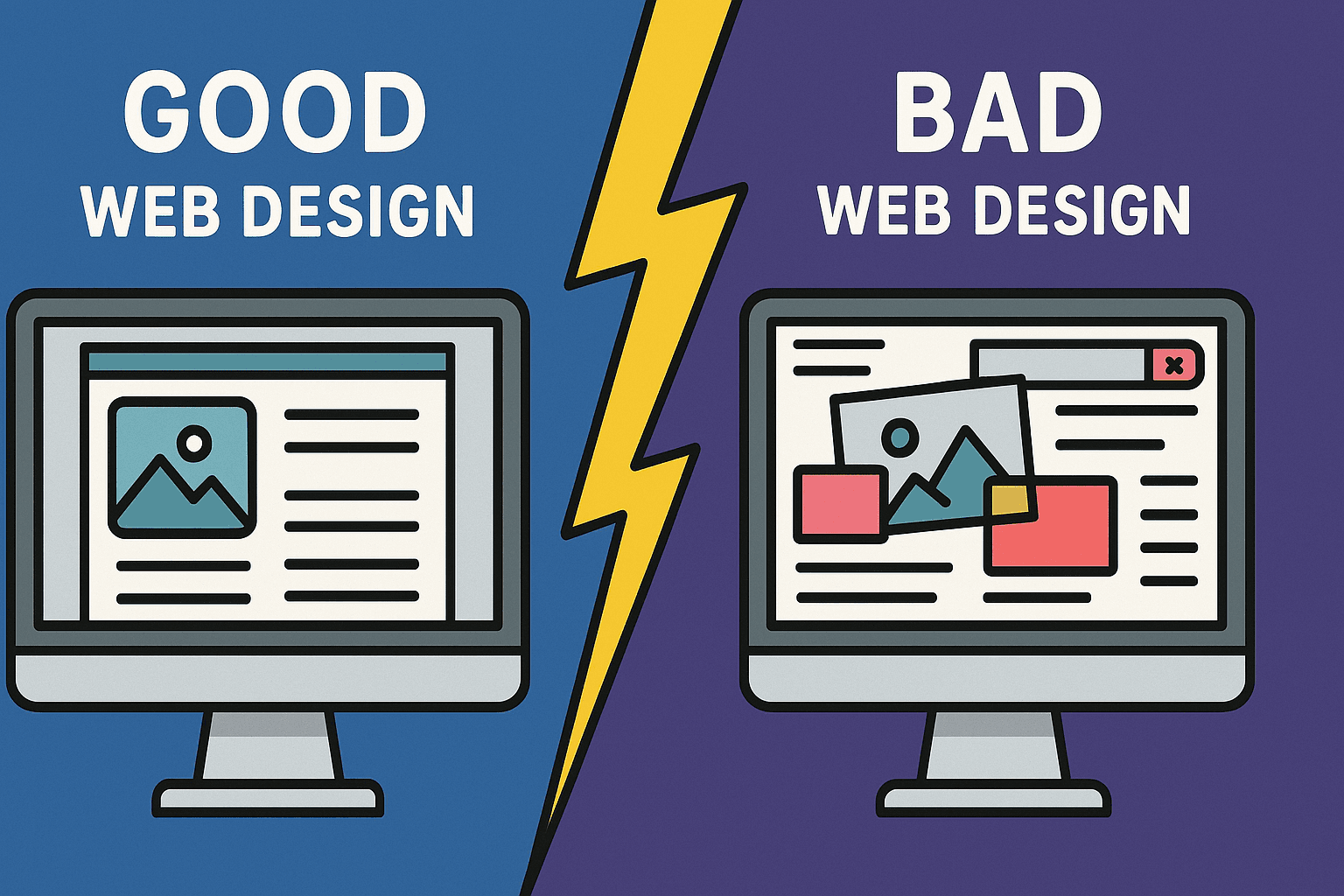
Why is web design important? Because your website is often the first contact a customer has with your business, and they judge you on it before they read a word. Good design earns trust, works on a phone, helps you rank, and turns visitors into enquiries. Poor design loses them quietly.
A professionally designed website sets the tone for everything after that first visit. A quick DIY site, or one left untouched for years, is tempting when you're busy. It also costs you enquiries you never hear about. This guide covers the importance of web design for a small business, and how to tell when yours needs work.
First Impressions Build Trust and Credibility
Visitors judge your business by its online presence, which usually means how your site looks and works. If the website design looks outdated, loads slowly or is hard to find your way around, many will leave for a competitor rather than get in touch.
In a crowded market, where several local businesses compete for the same customers, a poor site does the talking for you. Visual appeal matters, but trust and credibility come from consistency: the same branding, visual elements and tone on every page, so the site matches how you work in person.
Good Design Is Easy to Use
Good web design is mostly invisible. Visitors notice it only when it fails: when they can't find your prices, the menu hides the page they want, or the text is too small to read.
Intuitive navigation, a clear visual hierarchy and plain readability are what make a user-friendly website and a good user experience. People scan a page before they read it, often in what Nielsen Norman Group calls an F-shaped pattern: across the top, then down the left side. So the most important information belongs where their eyes land first. Simple design principles like these are the difference between a good website and one that only looks good.
Mobile Visitors Come First
Google uses the mobile version of your site for indexing and ranking, and many of your visitors will arrive on a phone. If your site isn't built for small screens, they will struggle to read it, tap buttons and find their way around.
Responsive design means the layout adapts to every screen size, rather than shrinking the desktop version until it is unusable. A mobile-friendly site keeps your business looking professional however people find you.
Web Design and SEO Go Together
How your website is built affects how search engines read it. If your site is slow, badly structured or missing key metadata, it will struggle to rank in search engine results, however good your written content is. Search engine optimisation, and the organic traffic it brings, starts in the design, long before anyone writes a blog post.
We build SEO-ready websites from day one, which means:
Clean, crawlable code with proper HTML tags
Fast loading times on every page
Proper headings and image alt text, which also help accessibility
Local SEO basics, so you show up in searches around your area, whether that's Nottingham or anywhere else
Design can't replace quality content, and keyword stuffing won't make up for a site that is hard to use. Design decides whether search engines and visitors can make sense of the content you have.
Design That Turns Visitors into Enquiries
A website earns its keep when visitors become customers. Conversion-focused web design builds every page around the next step you want a visitor to take, whether that is a call, a booking or a quote request.
One clear call-to-action on each page, placed where the visitor has the information they need to act
Contact details where people expect them, at the top of the page and in the footer
Forms that ask only for what you need, because every extra field is a reason to give up
A user journey that leads from the problem to the answer to the enquiry, without dead ends
None of this needs a big budget. It needs the site to be planned around your customers rather than around a template, which is why we design every website individually. Our conversion rate optimisation service covers existing sites, and our guide to web design vs web development explains who does what.
Speed, Security and Support
A website isn't a one-off project, and website performance matters long after launch. Slow pages frustrate visitors and can lose them before they reach your contact form. Your site needs to be:
Fast enough to keep visitors browsing
Protected by proper security measures, especially if you take payments online
Supported, so someone fixes it when something breaks
Our managed websites include hosting, security patches and updates, so you can focus on running your business.
Is It Time to Upgrade Your Website?
Your website may be holding you back if it is:
Several years old and never refreshed
Hard to use on a phone
Difficult to update yourself
Not showing up in Google search results
Looking dated next to your competitors
If several of these apply, a website redesign may be a better fix than patching the old site. Our guide to keeping your rankings through a redesign covers the SEO side, and how much a website costs sets out the prices.
Here is what one client said about working with us on their new site:
Working with Callum and the Tea Powered team made the creation of our new business website an absolute breeze. From start to finish, they provided clear guidance and valuable insights, ensuring the entire process was smooth and stress-free.
Book a free consultation to talk through what would help your business. No pressure, just practical advice about whether your website needs a refresh, a rebuild or better search visibility.
Callum Robley
Founder & Lead Developer, Tea Powered Projects
Callum is a full-stack developer and the founder of Tea Powered Projects, a web design, development, and hosting company based in Nottingham, UK. With over 15 years of industry experience, he specialises in building reliable, scalable digital solutions for businesses of all sizes.